ALGERIA SPLENDORS
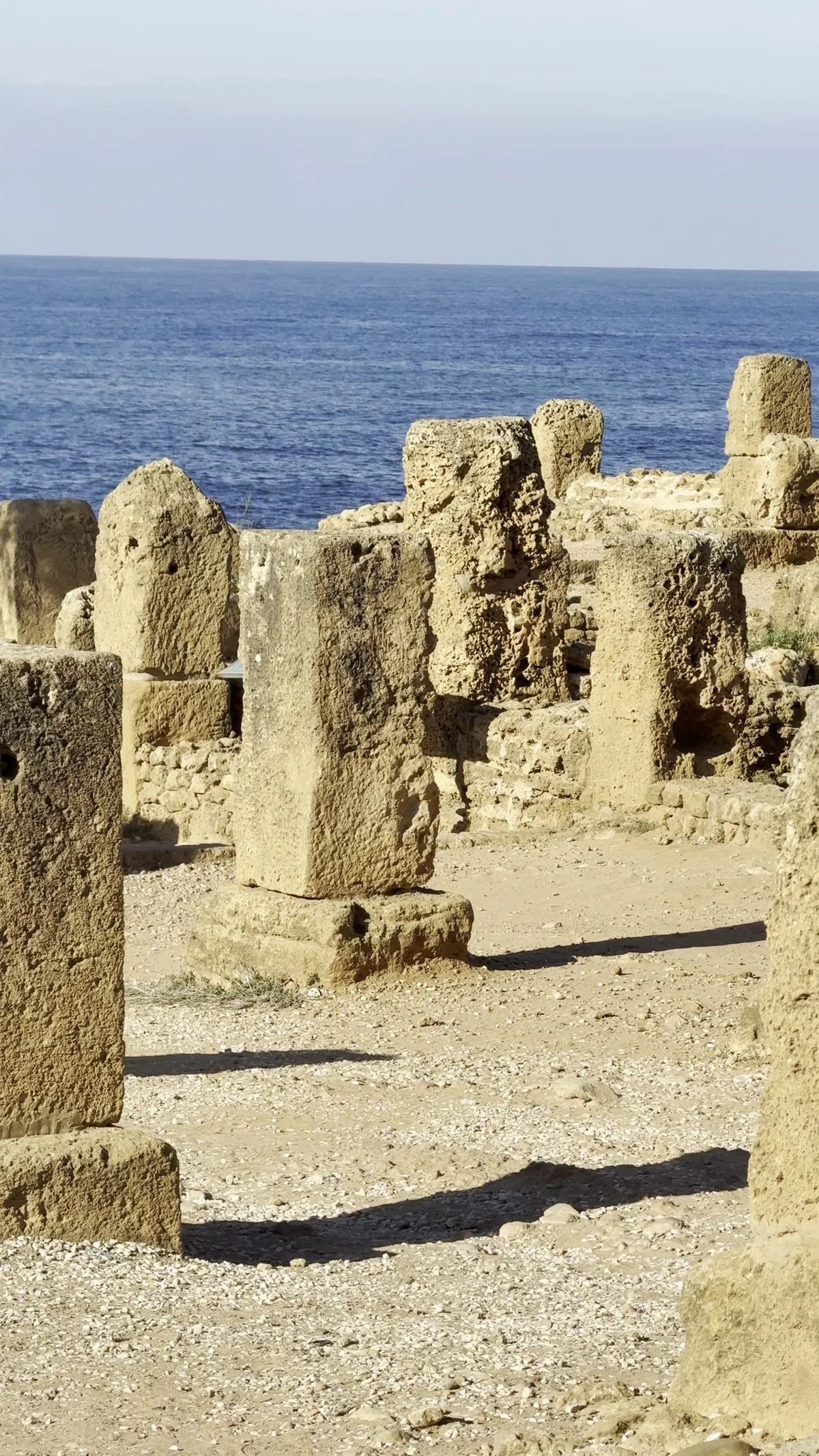
Inscription years and site facts are from UNESCO's country page for Algeria and its individual listings, checked 14 November 2026. This guide publishes no visitor statistics, because Algeria publishes none that can be verified — the emptiness described here is structural (a restrictive visa history, little international promotion) and observable, and the photograph above is evidence, not illustration: a World Heritage park, mid-morning, empty.
The strange arithmetic of Algerian heritage
Consider what the Mediterranean asks of you elsewhere. Rome rations its wonders through timed tickets. The famous medinas of the Maghreb run on well-worn visitor circuits. None of that machinery exists in Algeria — not because the substance is lesser, but because the pipeline that fills it was never built. Algeria's main English-language guidebook went eighteen years without a new edition. The world's best-known wonder-catalogue lists a dozen Algerian places, total.
The result is an anomaly a traveller can still use: seven World Heritage inscriptions, most of them visitable in near-solitude — provided you accept the country's terms. Those terms are real, and this journal does not hide them: a visa process that takes planning (our visa guide walks both genuine routes), cash logistics that reward preparation (our money guide), and, in the deep South, guided and sometimes escorted frameworks (mapped here). The crowds are absent. The homework is not.
Here are the seven, in the order a first journey might meet them.
1. Tipasa — Rome by the sea (1982)
An hour west of Algiers, the archaeological park of Tipasa spreads across a headland: a Punic trading post from the 6th century BCE, raised by Claudius to a Roman town of Latin status (about AD 46) and to a full colony a century later under Hadrian, its streets, basilicas and column stumps running down to the water. Above it stands the Royal Mausoleum of Mauretania, the great circular tomb of the Numidian royal house. Tipasa is the gentlest of Algeria's ancient sites — a park you stroll, with the Mediterranean doing half the work — and the one most easily combined with the capital. Our collaborators' footage, from which this article's photograph is taken, shows its other quality: space.
2. The Casbah of Algiers — the one that is alive (1992)
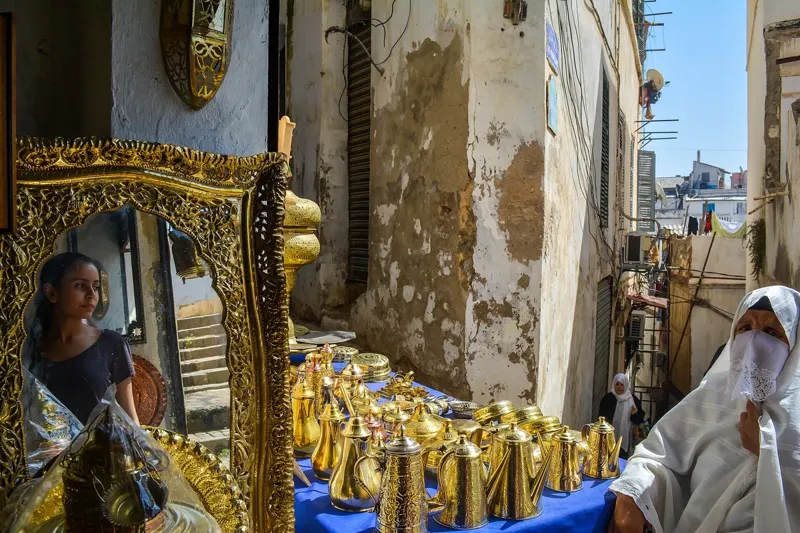
The Casbah is not a ruin and not a museum. It is a dense, inhabited old city — citadel, mosques, Ottoman palaces and thousands of households stacked above the bay of Algiers — inscribed in 1992 as an outstanding example of a historic Maghrebi city. It is also the one site on this list where "without the crowds" needs correcting: the Casbah has its own crowds, because it is a neighbourhood. What it does not have is a visitor industry. You walk it as a guest in a living city, which is a different and better discipline. Our cultural guide to the Casbah is written in that spirit.
3. Timgad — the complete Roman city (1982)
In AD 100, the emperor Trajan founded Timgad as a colony for veterans, drawn on the classic Roman grid — cardo, decumanus, forum, theatre, baths, library — at the foot of the Aurès mountains. Other Roman sites give you monuments. Timgad gives you the whole town, street plan intact, in dry mountain air that preserved what busier centuries would have built over. If you have ever stood in a famous Roman ruin wishing the other thousand visitors away, Timgad is the answer the map was hiding.
4. Djémila — the mountain theatre (1982)
Djémila, Roman Cuicul, was founded under Nerva in the late 1st century at 900 metres in the mountains of the Sétif highlands — a garrison town that had to bend Rome's grid to a steep site, and is more beautiful for it. Forum, temples, basilicas, a triumphal arch, early Christian buildings with a baptistery, celebrated mosaics: the full civic kit, arranged along slopes and terraces. Of Algeria's Roman cities, travellers consistently call Djémila the most graceful. It is also the most demanding of the three to reach — which is part of why its terraces are quiet.
5. Al Qal'a of Beni Hammad — the first capital (1980)
Algeria's first inscription, in 1980, is its most austere: the fortified first capital of the Hammadid dynasty, founded in 1007 in a mountain setting in today's M'Sila province: its court departed for Béjaïa in 1090, and its walls were partly demolished in 1152. What remains — palace ruins, fortifications, and the great mosque whose minaret is among the oldest in Algeria — influenced architecture across the Maghreb, Andalusia and Sicily. Beni Hammad asks the most imagination of any site here and rewards it with the deepest quiet of the seven.
6. The M'Zab Valley — five cities that still work (1982)
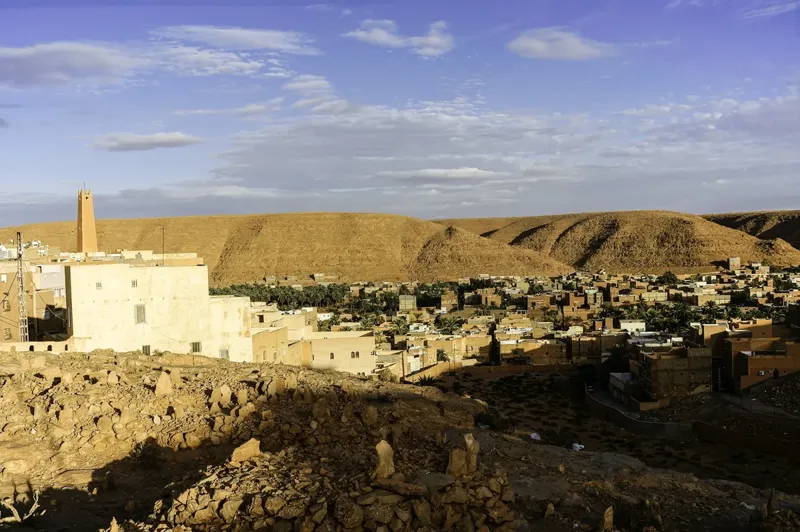
South of the Atlas, on the edge of the desert, the Ibadite founders of the M'Zab built five ksour — fortified hilltop towns — between 1012 and 1350 around Ghardaïa: each with its mosque-fortress and watchtower minaret, its cemetery, its palm grove, arranged by rules of community life that are still, remarkably, in force. UNESCO inscribed the valley in 1982 as an intact traditional habitat; Le Corbusier studied these towns, and modern architects still do. The M'Zab is not visited casually — its communities receive guests by their own customs, and local guidance is both respectful and practical — but a skyline of five desert cities, unchanged in principle for a thousand years, has no equivalent anywhere.
7. The Tassili n'Ajjer — the gallery at the end of the road (1982)
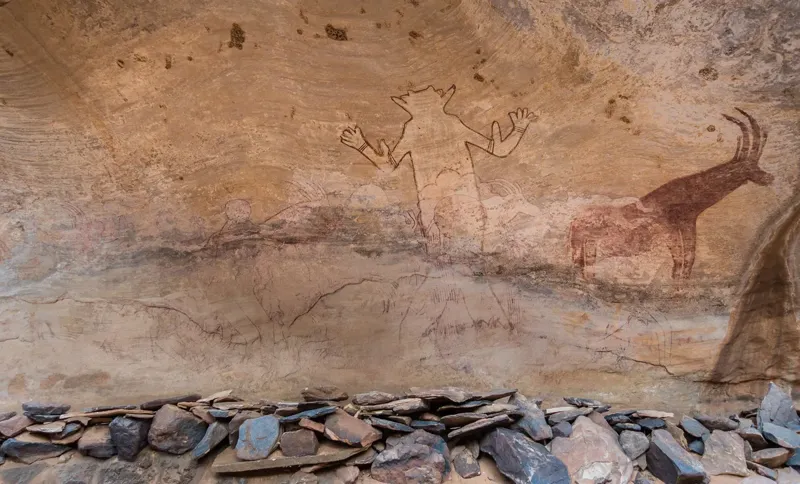
The seventh site is the one that dwarfs the category: a UNESCO-listed plateau of 72,000 square kilometres holding more than 15,000 recorded prehistoric paintings and engravings. It is also the one where solitude is guaranteed by geography and by rule — permit, licensed guide, days on foot. We have given it its own guide, because anything shorter would be a disservice: Tassili n'Ajjer: One of the World's Most Important Groupings of Prehistoric Rock Art.
How to build a journey from this list
A long weekend from Algiers: the Casbah, and Tipasa with the Royal Mausoleum — two inscriptions, no internal travel.
A northern loop (five to seven days): Algiers for the Casbah, east to Djémila and Timgad, with Beni Hammad for the traveller who wants the austere one. Roads are real distances; a driver or an organised circuit earns its cost here.
The deep journeys: the M'Zab as its own expedition south from the capital, and the Tassili as the full commitment described in its guide — permit, agency, season (the cooler months), and time.
And one honest caveat to end on. "Without the crowds" describes Algeria now — a function of visas, promotion and habit, not a law of nature. The eclipse of 2 August 2027, whose path of totality crosses the north of the country (our eclipse guide), will bring the country's first great wave of heritage visitors to Oran and the high plateaus. The quiet is real. It is not promised forever. That, for the traveller who values it, is an argument for going sooner — made by the facts, not by us.
Frequently asked questions
How many UNESCO World Heritage sites does Algeria have? Seven: Al Qal'a of Beni Hammad (1980); Djémila, Tipasa, Timgad, the M'Zab Valley and the Tassili n'Ajjer (all 1982); and the Kasbah of Algiers (1992). Six are cultural; the Tassili is a mixed cultural and natural inscription.
Are these sites really uncrowded? By the standards of comparable Mediterranean sites, yes — Algeria's restrictive visa history and minimal international promotion keep international visitor numbers low, and no timed-ticket or queueing infrastructure exists at these sites. Domestic visitors and school groups do come, above all to Tipasa and the Casbah; "uncrowded" never means "yours alone", and the Casbah is a living neighbourhood.
Which site is easiest to visit? Tipasa, an hour from Algiers, in combination with the Casbah. Which is hardest: the Tassili n'Ajjer, by days of walking and a permit regime — see its dedicated guide.
Do I need a guide for the northern sites? The northern archaeological sites can be visited without the South's escort framework, but arrangements vary and a local guide transforms the Casbah and the M'Zab in particular — in the M'Zab, local guidance is the custom of the place. The visa itself, for most nationalities, is arranged with an itinerary; see our visa guide for the two genuine routes.
When is the best season? Spring and autumn for the north; the cooler months, roughly October to April, for the M'Zab and the Sahara.
Algeria Splendors writes from Algeria. The photograph at the top of this article is a still from footage shot at Tipasa by our collaborators Kati & Fateh — their rushes from Tipaza, Tlemcen and Oran power much of this journal's film work.