ALGERIA SPLENDORS
Facts about the site and its protection are from UNESCO's listing (checked 14 November 2026). Access rules are summarised from the park's published requirements and current operator practice; durations are typical trek formats reported by licensed operators, not guarantees. Where a detail rests on traveller or operator reports rather than an official source, this guide says so.
A plateau that kept a diary
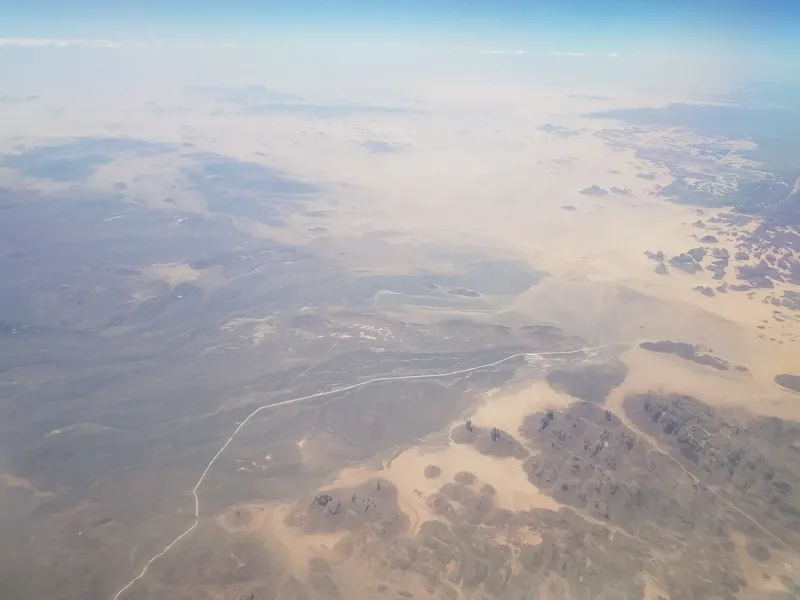
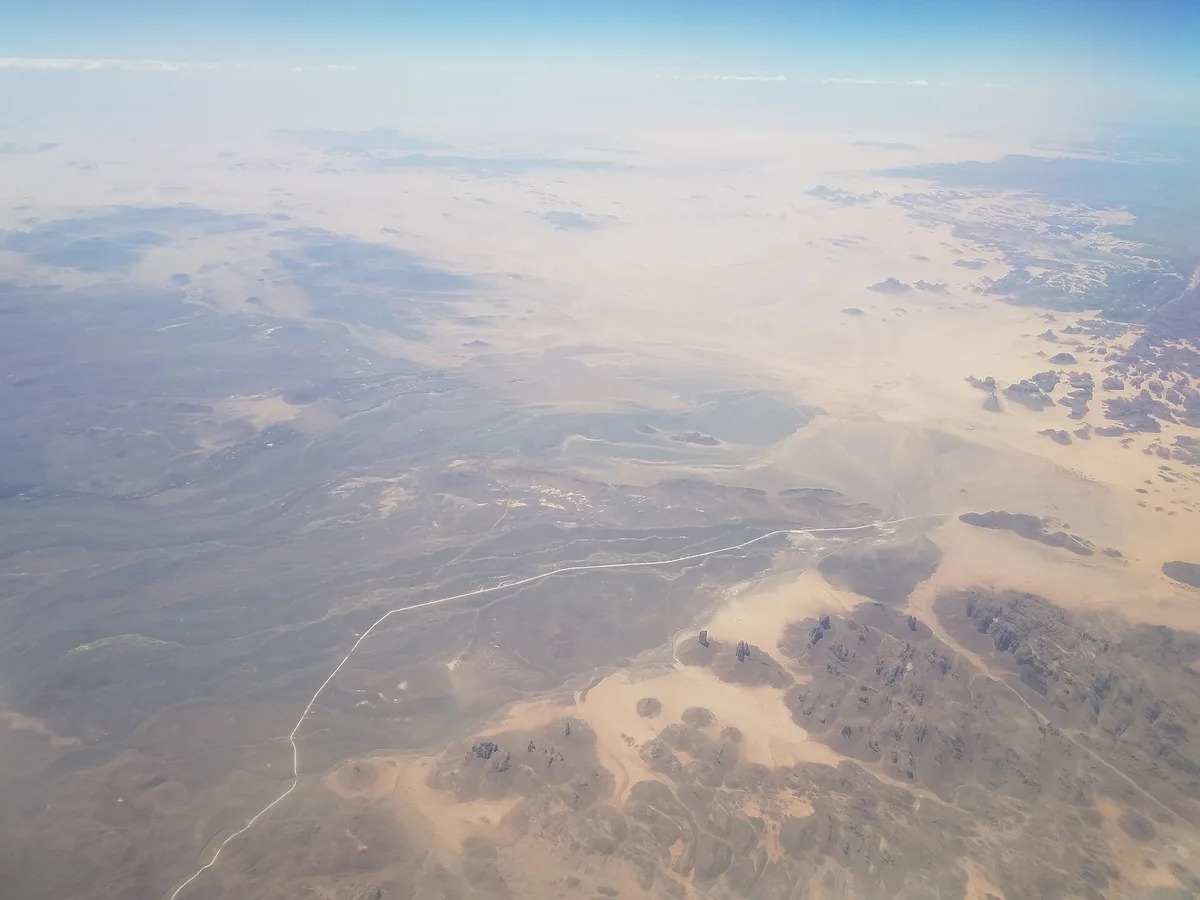
From the air, the Tassili n'Ajjer is a dark stone sea: a sandstone plateau in the far south-east of Algeria, where the borders of Libya, Niger and Mali meet, eroded over ages into canyons, stone forests and natural arches. The property UNESCO inscribed covers 72,000 square kilometres — and under its cliffs and inside its rock shelters, people painted and engraved what they saw for roughly ten thousand years.
UNESCO's count stands at more than 15,000 identified engravings and paintings — the tally made for the 1982 listing; later surveys suggest the true total is far higher, and the inventory is still growing. The art first reached outside attention in 1933, when a French officer's surveys in the Oued Djerat were reported — European travellers had noted paintings as early as 1909, and worldwide fame came with the Lhote expeditions of the 1950s. Algeria made the plateau a national park in 1972, UNESCO inscribed it on the World Heritage List in 1982 for both its culture and its landscapes, and it became a biosphere reserve in 1986. The park is administered from Djanet, the oasis town at the plateau's foot.
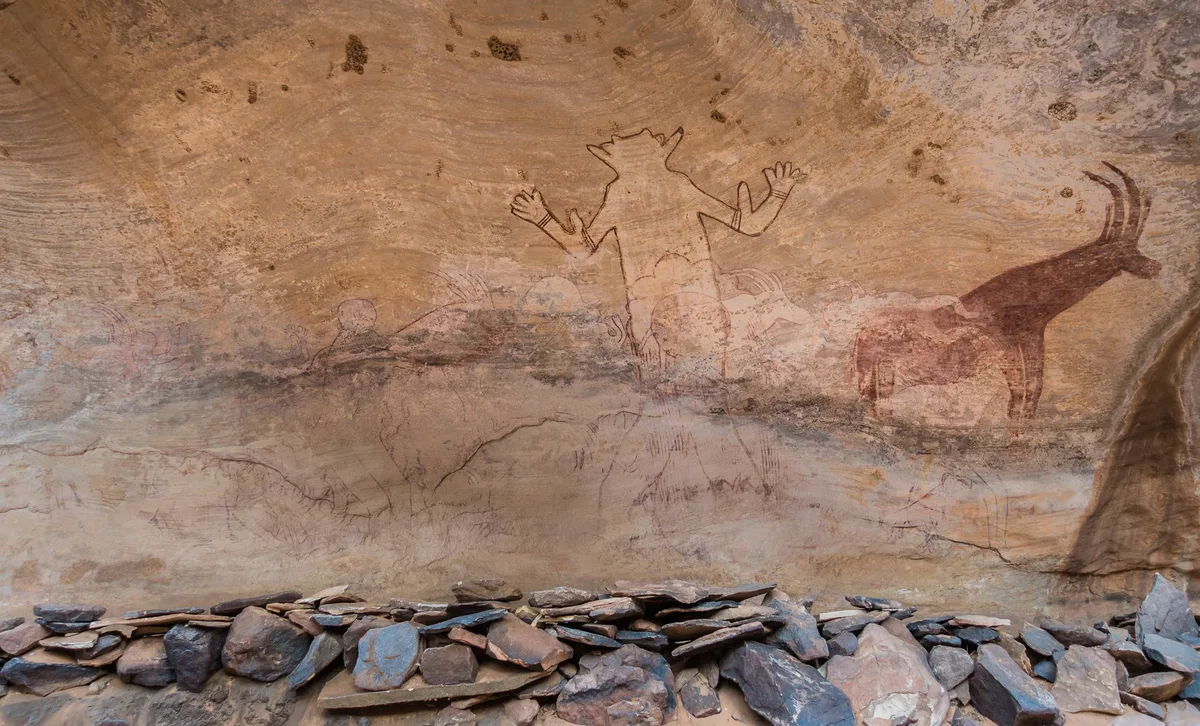
What makes the Tassili different from every other rock-art region on Earth is not only the quantity. It is the sequence. Read in order, the walls narrate the death of a green Sahara — one of the great climate stories of the human past, told by the people who lived it.
Reading the walls: four chapters
Specialists divide the art into broad periods. The labels and dates are still debated — treat the framework as a reading aid, not settled law — but once you know the chapters, the shelters start to make sense.
The wild-fauna engravings. Large engravings of wild animals — giant buffalo, elephants, giraffes, rhinoceros — record a plateau that held water and grass where today's stone desert now stands. Older accounts made them the first chapter, a hunters' age before herding; current research instead places many of them alongside the earliest cattle pastoralism, far later than once thought.
The Round Heads. The plateau's oldest paintings are stranger: human forms with featureless round heads, some apparently floating, some in scenes that UNESCO describes as evoking magic-religious practices. The ground the painters stood on is at most some 10,000 years old, and recent research dates the paintings themselves later — their exact age is still debated. They are among the most haunting images in all prehistoric art, and nobody can tell you with certainty what they meant. Any guide who claims otherwise is performing, not informing.
The cattle herders. Then the walls fill with daily life: herds of long-horned cattle, camps, dances, people in dressed hair and jewellery. UNESCO calls these pastoral scenes amongst the most famous prehistoric parietal art in existence. This is the green Sahara at its height — a populated, working landscape, painted by the people who worked it.
Horses, then camels. The last chapters track the drying. Horses and chariots appear, then — as the desert wins — the camel, the animal that made the empty Sahara crossable. The diary closes with the landscape you are standing in.
One image has become the plateau's emblem: the "crying cow" of Tegharghart, near Djanet, a finely carved cow with what looks like a tear on its cheek. It is reproduced everywhere. On the plateau itself, a week of walking shows you a thousand images no photograph has made famous.
The two great sites
Sefar is the plateau's wonder: a natural stone city, a labyrinth of sandstone towers and corridors spread over a wide area, its shelters painted across all the periods. Operators typically build treks of seven to ten days around it, rated hard — a steep climb onto the plateau, then days of walking with donkeys or porters carrying the loads. Travellers consistently describe Sefar as the finest concentration of art on the plateau; the claim is a judgement, but it is a widely shared one.
Jabbaren — the name is usually translated "the Giants", for its large painted figures — holds painted shelters of exceptional richness, again spanning the periods. It is reached by a separate route: walked to alone from Djanet it takes one to three days, but operators more often give it five to seven days as the core of a short plateau stay combined with Tamrit or Sefar. Between the two, most treks pass Tamrit, a shelter area where some of the earliest recorded plateau paintings were documented by the French expeditions of the 1950s.
Shorter formats exist — four to five days can climb to the plateau and cover Tamrit and a selection of sites — but they are samplers, not the full text. The honest arithmetic of the Tassili is that its masterpieces are measured in days of walking, not hours.
On the ground — the practical half of this dossier
How a trek actually works
There is no independent access. The park requires a permit, arranged in advance, and a licensed local guide; visits run through approved local agencies, normally based in Djanet. UNESCO describes tourism at the property as strictly controlled, and groups are always accompanied by an official guide; permits and accompaniment are arranged in advance — there is no free visiting of the sites. Your agency handles the permit file — and, for foreign visitors, the trek sits inside the wider Algerian framework for travel in the South: agency-organised itineraries, and on some sectors, official escorts. Our companion guide maps those rules in full: Free, Guided or Escorted? The Honest Map for Travelling Algeria's Sahara.
Getting to Djanet is itself a leg of the journey. Djanet has an airport with domestic flights from Algiers (schedules change; verify before building an itinerary around them). Overland approaches from the north are long desert drives that pass through the guided-and-escorted framework described above — nobody should plan to simply drive down and start walking.
On the plateau, you walk. Loads move by donkey or porter; camps are bivouacs, water is carried and rationed by the team's plan, and the walking day follows the temperature — early starts, shade at midday, art in the shelters when the light is kind. Fitness is not a formality: the climb onto the plateau and the distances between sites are real, and the honest operators say so. Season matters as much: the trekking season runs through the cooler months, roughly October to April, and mid-November — when this guide is published — sits in the heart of it.
Protection rules are strict and simple: never touch, wet or trace the paintings, and no flash photography at the art. The images survived ten thousand years of weather; the park's rules exist because a decade of careless hands could do what millennia of wind did not.
What it costs, honestly
Because every visit is an organised trek, the price is a package — agency, guide, permits, team, food, animals — quoted per itinerary and group size, in dinars. Published operator ranges for the high-plateau treks run to the tens of thousands of dinars per person; treat any figure you find online, including in guides like this one, as a starting point for a written quote, not a price list. Two of our other guides will help you sanity-check a quote: Money in Algeria explains the official and parallel exchange rates and why they change what a dinar quote really costs you, and the escort guide above explains which parts of a southern itinerary are rules and which are habits.
What no operator can sell you is a guarantee: of weather, of a specific shelter being on your exact route, or of the authorities' requirements staying identical between your booking and your trek. Get the itinerary, the inclusions and the cancellation terms in writing — that advice, repeated across every current source on Algerian desert travel, is the most useful sentence in this guide.
Is it for you?
Go if: you can walk for days, sleep rough gladly, and stand in front of a painted giraffe — engraved when the Sahara had rivers — and feel the floor of history move. There is nowhere else on Earth where the gallery is this large, this old, and this empty of crowds.
Do not go if: you need the trip to be adjustable day by day, or your fitness is a hope rather than a fact, or your schedule cannot absorb the permit and authorisation lead time that southern Algeria requires. The Tassili does not bend. That is precisely its value — and the reason the paintings are still there to be read.
Frequently asked questions
Can I visit the Tassili n'Ajjer independently? No. Access requires a park permit and a licensed guide, arranged through an approved agency, normally in Djanet. Foreign visitors also sit inside the wider authorisation framework for Algeria's South.
How many paintings and engravings are there? More than 15,000 were recorded for UNESCO's listing, across a period of roughly ten thousand years; later surveys suggest the true total is far higher, and the inventory continues to grow as survey work proceeds.
What is the best time of year? The cooler months, roughly October to April. Summer heat on the plateau makes long walking days dangerous rather than merely unpleasant.
How long do I need? Four to five days for a plateau sampler (Tamrit and selected sites); seven to ten days for Sefar; one to three days' walking for Jabbaren alone, or five to seven for a short plateau stay built around it. Add travel to and from Djanet at both ends.
How do I get to Djanet? By domestic flight from Algiers to Djanet's airport, on schedules that change — verify before planning. Overland routes are long and fall under the guided/escorted framework for the South.
Can I photograph the paintings? Yes, without flash — and never touch, wet or trace the art. Those are park rules, stated here as the park states them.
Algeria Splendors writes from Algeria. Companion reading: The Honest Map for Travelling Algeria's Sahara · Money in Algeria · The Eclipse of the Century Over Algeria