ALGERIA SPLENDORS
Figures below are computed from NASA eclipse data (via timeanddate and the Totality Atlas) and checked on 13 November 2026. Durations vary by a few seconds with your exact position.
Why Algeria, why Oran
Ask what makes an eclipse worth crossing a sea for. Is it the seconds on a stopwatch, or the odds of standing under a clear sky when those seconds arrive? On 2 August 2027, both point towards North Africa. The shadow comes ashore near the Strait of Gibraltar in mid-morning and runs east along the southern rim of the Mediterranean, skirting the northern Sahara — hot, dry country where August cloud is the exception rather than the rule. Eclipse climatologists place this among the least cloudy eclipse paths analysed in decades.
Algeria takes a long share of that track. The shadow comes ashore at Oran, sweeps across the plains and the high plateaus, lifts over the Aurès, and leaves past Tébessa towards Tunisia. Eclipse guides note it is the first total eclipse over the populated north of the country since 1905. Few countries offer so many observing sites inside one border, reachable on ordinary roads.
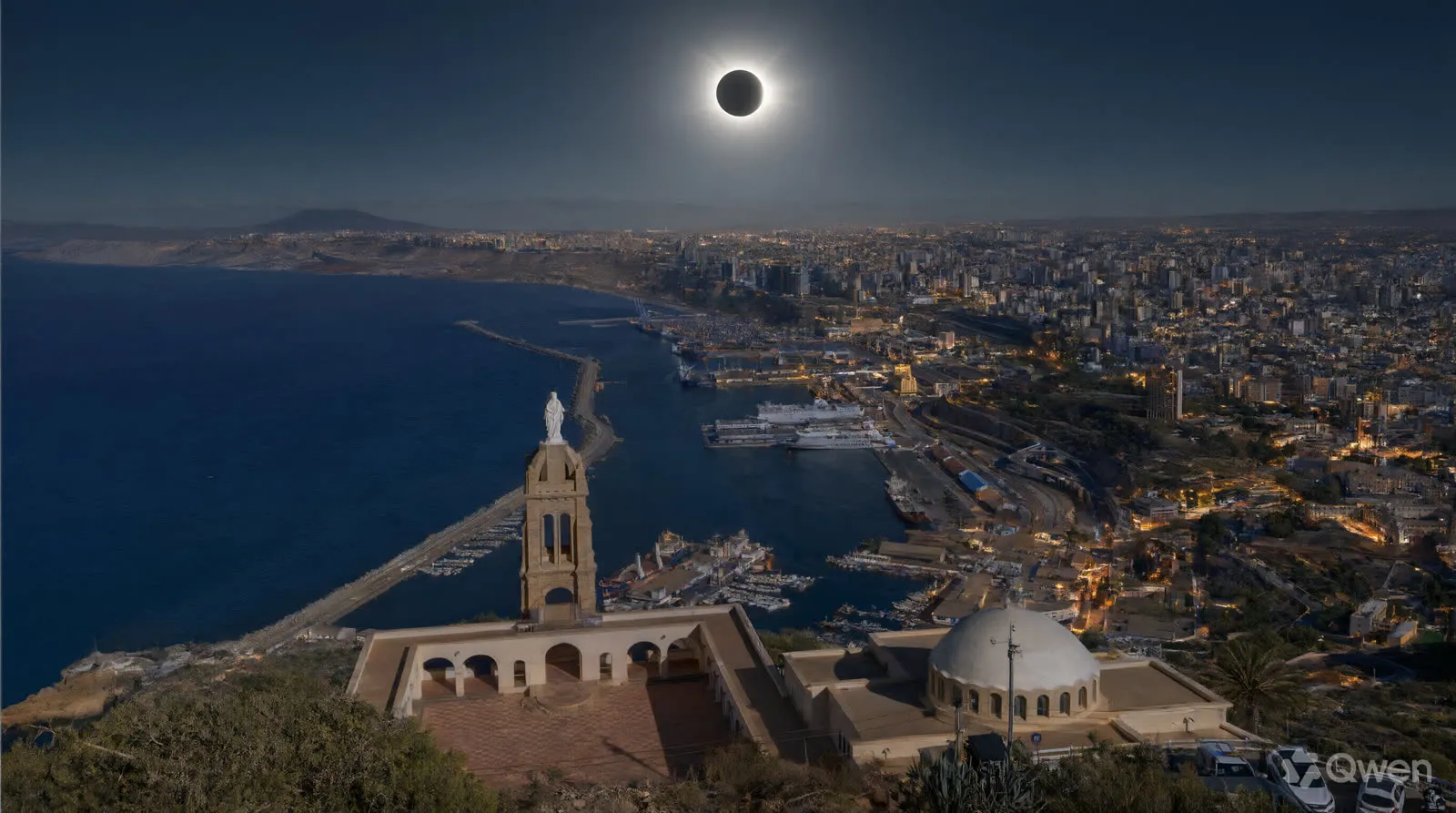
Oran's claim is specific: 5 minutes 9 seconds of totality, beginning at 9:51 a.m. local time, with the Sun 43° up in the east-southeast. That is among the longest totality available anywhere on Earth for this eclipse; only the Nile valley near Luxor does better, at 6 minutes 23 seconds — the longest land totality between 1991 and 2114. Five minutes matters more than it sounds. Two minutes is a gasp; five is long enough to study the corona, find Venus, notice the birds, turn to the people beside you, and look back up.
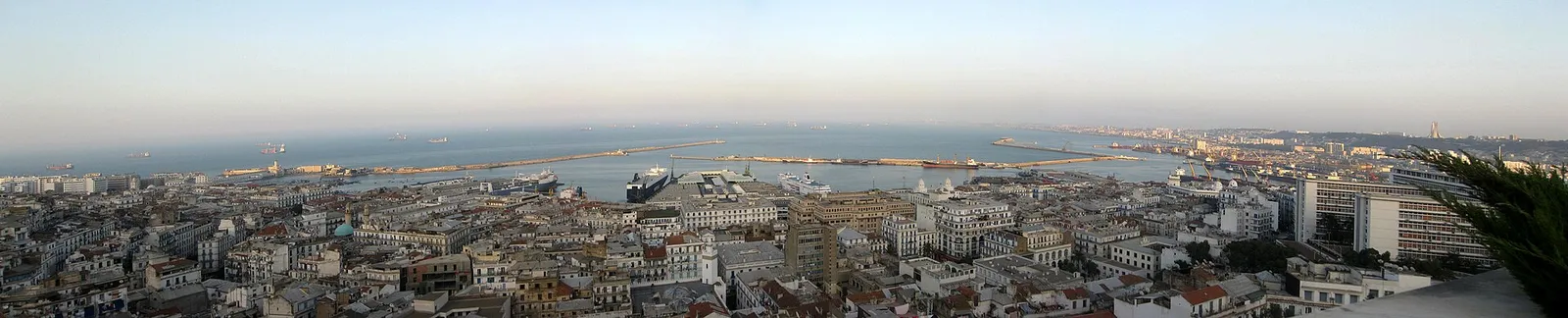
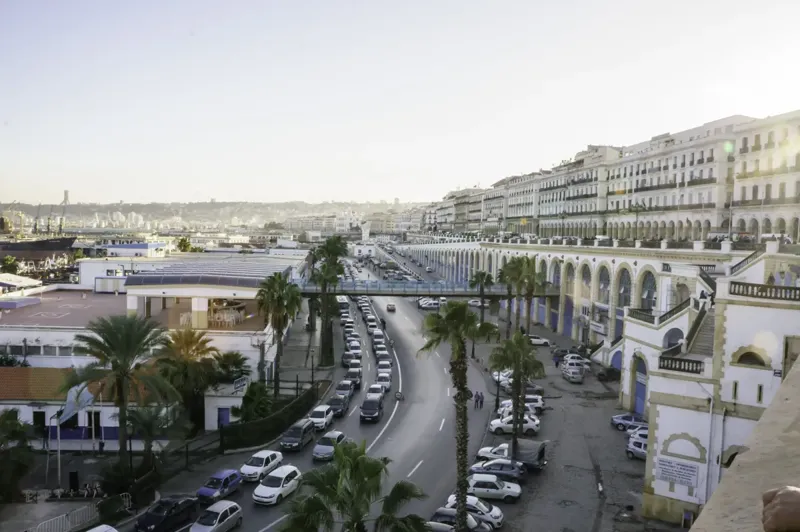
Then there is the city itself. Oranais call Oran el-Bahia, the radiant. It is a port of layered histories — Andalusian founders, two spells of Spanish rule, an Ottoman beylik, a French colonial grid, and the raï music that carried its name across the world. You are not coming to a viewing platform in a field. You are coming to a working Mediterranean city that happens to be standing in the shadow.
One caution belongs here rather than in the small print. Coastal North Africa can wake under marine stratus — low cloud that forms overnight over cool water and usually burns off after sunrise. The eclipse is at mid-morning, which helps; serious observers still keep a vehicle and a plan to move twenty or thirty kilometres inland if the morning looks grey.
The path of totality across Algeria
Totality is a narrow ribbon, not a national event. Inside it, the Sun's disc vanishes completely and the corona appears; outside it, even by a few kilometres, you get a bright crescent and none of the darkness.
| Place | What you will see | Totality |
|---|---|---|
| Oran (coast) | Total eclipse; corona, twilight sky, mid-morning | 5 min 9 s (from 9:51 a.m.) |
| Batna / Aurès foothills | Total eclipse; mountain terrain, drier air | ≈ 5 min 17 s |
| Tébessa | Total eclipse at the path's eastern exit | ≈ 5 min 12 s |
| Biskra | Total eclipse at the desert gate | ≈ 5 min |
| Sidi Bel Abbès | Total eclipse on the plains inland from Oran | ≈ 4 min 34 s |
| Médéa | Total eclipse south of Algiers | ≈ 4 min 1 s |
| Blida | Total eclipse — the closest totality to the capital | ≈ 2 min 50 s |
| Tlemcen | Total eclipse, nearer the path's southern edge | ≈ 3 min 12 s |
| Algiers | Partial only — 99.8% covered, no corona, no darkness | — |
Durations depend on your position relative to the centre line; check an interactive eclipse map for your exact spot before committing. Places near the edges lose minutes quickly; towns along the axis hold five minutes or more.
Algiers deserves a plain warning because its number looks tempting. The capital sees 99.8% of the Sun covered. That is still daylight. No corona, no stars, no sudden chill. A 99.8% partial eclipse and a total one are different experiences, not different degrees of the same one. If you fly into Algiers, plan the transfer: Blida and Médéa, under an hour away, are inside the path.
The Aurès and the high plateaus offer the other trade-off. The mountains generate a little more morning cloud than the surrounding steppe — a modest increase, not a disqualifying one — while the plateau itself is dry and largely clear. Dust, rather than cloud, is the interior's variable: a sirocco can lay a translucent pall across the sky that softens the corona without hiding it.
Building the trip around the eclipse: Oran and Tlemcen
Put the eclipse near the middle of the week, not at its end. Arrive two or three days early, learn the city, scout your observing spot at the same hour the eclipse will happen, and keep the following days for Tlemcen.
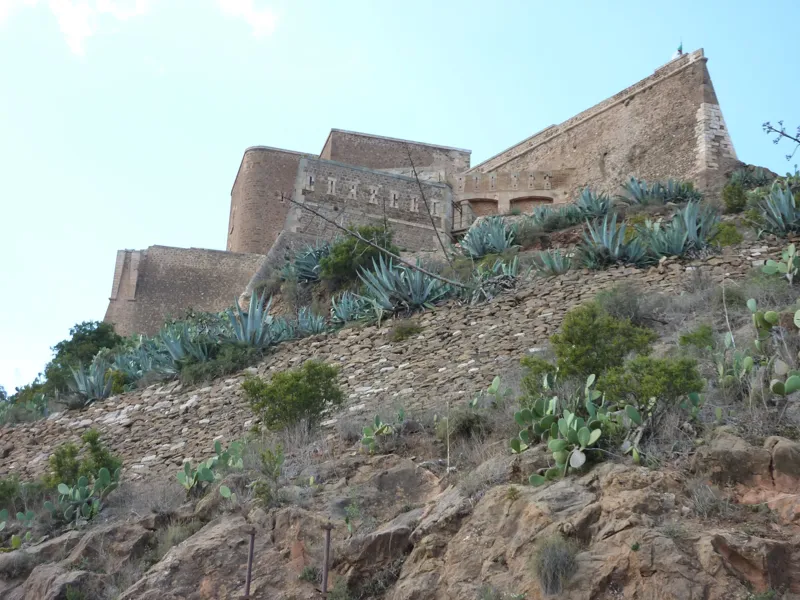
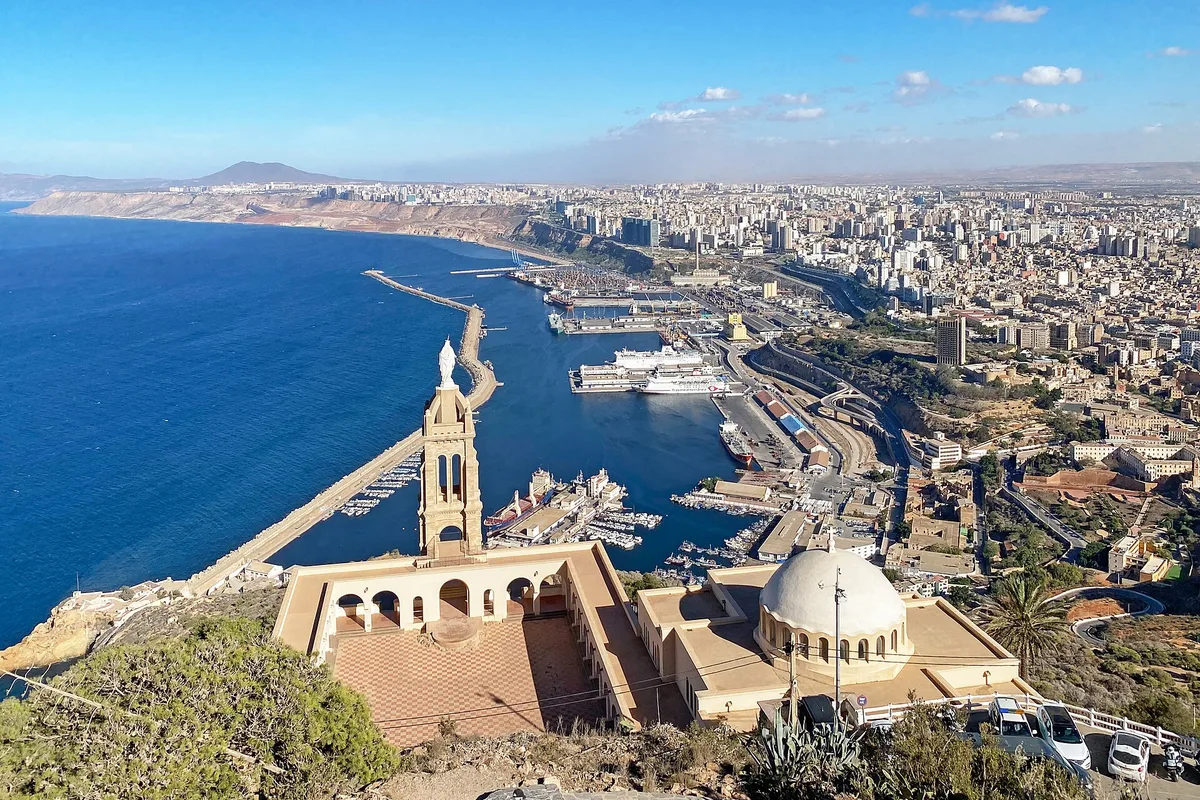
In Oran, climb to Santa Cruz. The fortress was raised by the Spanish in the sixteenth century on the shoulder of Mount Murdjajo, above the bay, with the white chapel of Notre-Dame de Santa Cruz beside it and the whole port laid out below. Go at nine in the morning a day or two before, and you will see exactly the light — and any haze — you can expect on the day. Below, the historic centre gathers around Place du 1er Novembre: the city hall flanked by its stone lions, the theatre, arcades that fill with families after dark. Walk down to Sidi El Houari, the old quarter by the harbour, where Ottoman-era mosques sit quietly beside everyday commerce. The former Sacré-Cœur cathedral, now a public library, tells you how this city reuses its buildings.
Tlemcen is the reason to stay a week. An inland city of orchards and cliffs, it was the seat of the Zayyanid sultans for three centuries and kept the manners of a capital. The Great Mosque, founded under the Almoravid emir Yusuf ibn Tashfin in the eleventh century, holds a pierced, ribbed dome before the mihrab that is among the finest surviving pieces of Almoravid work anywhere; light filters through its openwork like water through a sieve. Nearby, the Mechouar preserves the walls of the royal citadel. Add the mosque of Sidi Boumediene on the hill above town, and the ruined minaret of Mansourah standing in the fields outside — a siege city left unfinished, now a landmark for shepherds.
Tlemcen is inside the path, but with roughly three minutes of totality: treat it as a place to visit rather than the place to stand.
Practicalities
Eye safety. For every partial phase — and for the whole event in Algiers — use eclipse glasses certified to ISO 12312-2, and, for instruments, the full rule: during the partial phases — outside totality — binoculars, telescopes and camera lenses require a special solar filter secured over the front of the optics; never look at the Sun through an instrument while wearing your eclipse glasses — they do not protect you in that case. Ordinary sunglasses are useless. Inspect glasses for scratches, buy from a traceable supplier, and supervise children. Only during totality itself, when the Sun's disc is completely hidden, may you look unfiltered; put the glasses back on the instant the first bright bead returns.
Book early. Oran and Tlemcen have finite hotel stock, and August is already the season when Algerian families return from abroad. Reserve rooms and any car with a driver months ahead, confirm in writing, and keep the night of 2 August flexible in case weather forces a move.
August heat. Expect strong sun and, inland, temperatures that make midday walking unpleasant. Do as locals do: early mornings, a long shaded pause through the afternoon, evenings out late. Carry more water than seems necessary. The few minutes of totality bring a noticeable drop in temperature — pleasant, but no substitute for pacing yourself.
Visas. Most foreign visitors need a visa arranged in advance through an Algerian consulate. The arrival regularisation handled by approved agencies applies only to organised tours of the Great South — it does not cover an independent trip to Oran. Algeria welcomed about 3.5 million visitors in 2024, and consular demand in eclipse week will be unusual: start early. (Our full guide: Algeria Visa, Explained Without the Errors.)
What to do with the rest of the week
Give the coast a day. West of Oran, Les Andalouses and the beaches towards Aïn El Turk are where the city swims; the corniche at dusk, with grilled sardines, is the local version of a festival. East lies Mostaganem, also inside the path, with an old town above its port.
With four or five spare days and a taste for Roman stone, drive east: Tipaza's ruins run down to the sea in a setting Camus wrote about, and Cherchell's museum holds mosaics that repay slow looking. Further on, Constantine hangs over its gorge on its bridges, and Djémila, on its plateau, is among the best-preserved Roman towns in North Africa.
Prefer to follow the shadow inland? The Aurès are a different Algeria: Chaouia villages, terraced orchards, canyon roads towards Ghoufi, and Batna as a base. The Sahara proper — Ghardaïa, Timimoun, Djanet — is a serious journey requiring an approved agency, and August is its hardest month. Save it for another season, and let this trip belong to the north.
FAQ
When is the eclipse? Monday 2 August 2027, mid-morning. In Oran, totality runs from 9:51 to about 9:56 a.m. local time; the partial phases span 8:44–11:09 a.m.
Where is totality longest in Algeria? Along the centre line: about 5 minutes 30 seconds in the Aurès around Arris, 5 minutes 17 seconds at Batna, and 5 minutes 9 seconds at Oran.
Is Algiers in the path? No. Algiers sees a 99.8% partial eclipse — dramatic, but daylight. The nearest totality is Blida (≈2 min 50 s) and Médéa (≈4 min 1 s).
Do I need a visa for Algeria? Most foreign nationals do, obtained in advance from an Algerian consulate. Southern tours booked through approved agencies use a separate arrival arrangement that does not apply to Oran.
Is August a good time to visit Algeria? For the coast and the northern mountains, yes — hot, dry, reliably sunny, with lively evenings. For the deep Sahara, it is the wrong month.
Sources
- NASA eclipse computations via timeanddate — Oran, 2 Aug 2027: https://www.timeanddate.com/eclipse/in/algeria/oran?iso=20270802
- Totality Atlas — Algeria viewing guide (NASA path data): https://www.totalityatlas.com/where-to-watch/algeria
- Space.com — Total solar eclipse 2027, "eclipse of the century": https://www.space.com/total-solar-eclipse-2027-everything-you-need-to-know-where-when-to-see
Algeria Splendors is an independent cultural publication from Algeria.
The field guide (PDF)
The journal's eclipse field guide — The 2027 Eclipse Field Guide, version 3 (PDF) — carries the same facts in two printable pages. Version 3, dated 15 November 2026, corrects the journal's address as printed in the guide; version 2 corrected the eye-safety page to the full NASA rule above. Both corrections are logged on our Verified & corrections page.