ALGERIA SPLENDORS
This dossier is the city companion to our solar eclipse guide: the eclipse brings the world to Oran on 2 August 2027; this is for the days around it. Historical dates follow the standard documented record and were checked against our research notes in November 2026; opening arrangements and the like change, and are flagged for verification before travel.
Five minutes of night, a week of city
The astronomy is settled, and our eclipse guide gives it in full: totality over Oran from 09:51, lasting 5 minutes 9 seconds, the Sun 43 degrees up in a summer morning sky. What no ephemeris can tell you is what kind of city receives an event like that. Oran's answer is written in its stone, and it is a good one: this is a place that has been receiving the world — merchants, fleets, exiles, musicians — for eleven centuries, and has kept something from every arrival.
Read the bay first
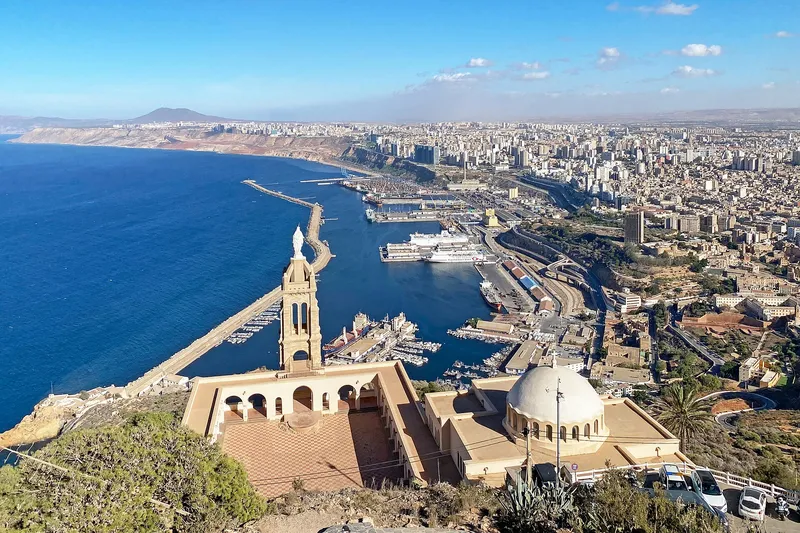
Oran stands on the western arm of a wide bay, its quarters climbing from the port toward the plateau of the Murdjadjo, the flat-topped mountain that closes the city to the west. Everything in Oran's history follows from that geography: a defensible harbour, fresh water in the ravines below the mountain, and a roadstead watched from above. The Spanish, who held Oran for most of the period between 1509 and 1792, built their watching-place on the Murdjadjo's shoulder — and it is still the city's crown.
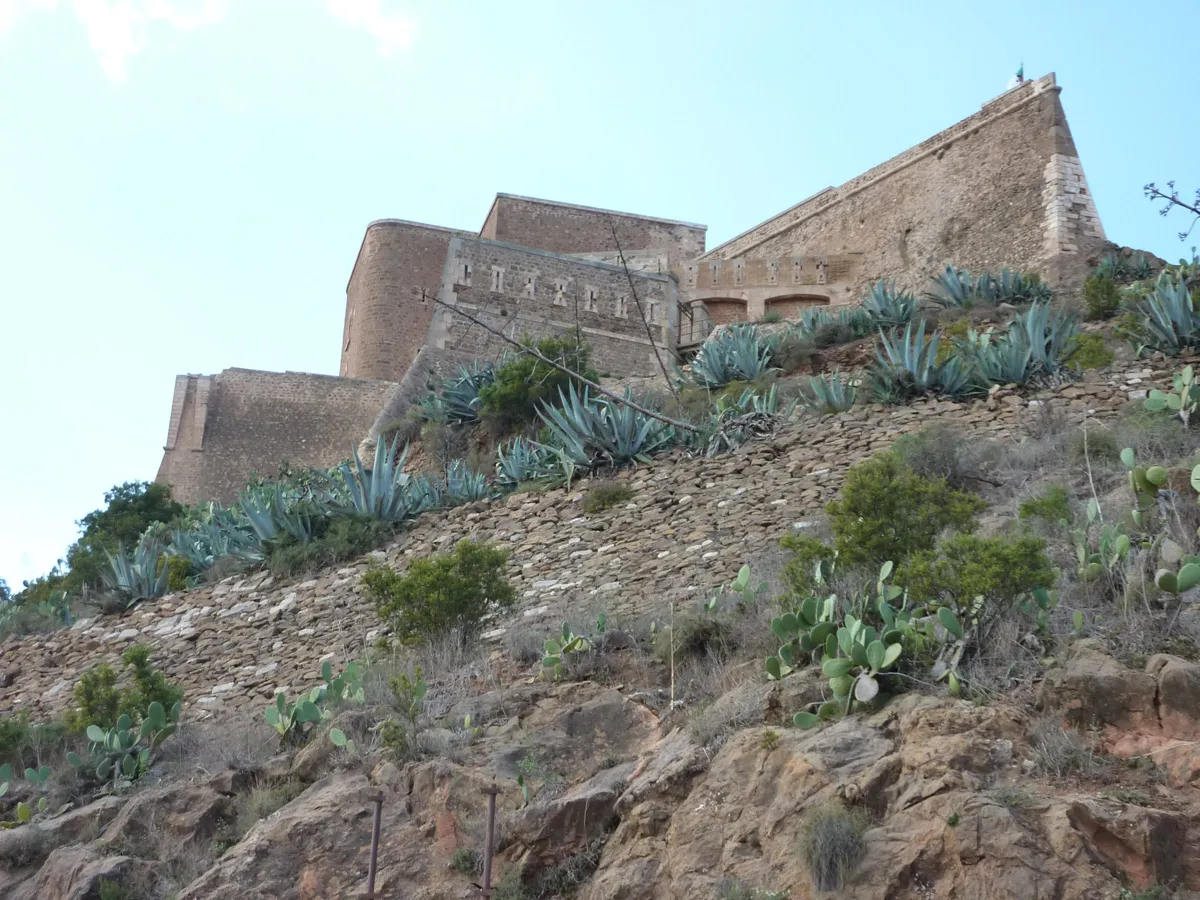
Santa Cruz. The fortress of Santa Cruz, built and rebuilt by Spain between the 16th and 18th centuries, commands the bay, the port of Mers el-Kébir to the west and the whole city below. Beside it stands the chapel of Notre-Dame de Santa Cruz, raised in the 19th century after a cholera epidemic, its tower carrying the statue of the Virgin that every Oranais knows as the city's guardian — the same statue that appears, small and white, in the photograph at the head of our eclipse guide. Go up in the morning, when the light is on the bay: the view is the city's whole argument in one frame — harbour, old town, new town, mountain, sea. On eclipse morning, the Moon's shadow will cross exactly this water. You will already know it by name.
The layers, street by street
Sidi El Houari — the Spanish and Ottoman town. The oldest surviving quarter sits in the ravine west of the centre, around the tomb of the city's patron saint. Here are the Spanish-era churches and forts' lower works, the Bey's palace — the residence of Oran's Ottoman governors, an 18th–19th-century palace of courtyards and tilework — and the Hassan Pacha mosque of the 1790s. This is Oran before the boulevards: steep, shaded, dense with shrines.
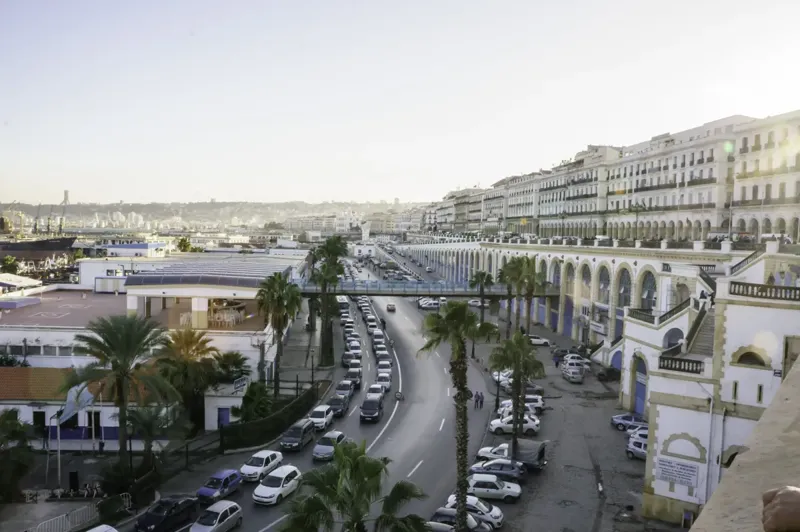
The colonial grid — a Mediterranean showcase. The French city rose on the plateau above: the Place du 1er Novembre with its obelisk, the municipal theatre (an opera house in all but name, opened in the early 20th century), the Sacré-Cœur cathedral — now the city's public library, its reading rooms under the nave — and the sweeping waterfront boulevard, the Front de Mer, built along the cliff edge with the bay permanently in view. Two buildings tell the city's plural history in one glance each: the Great Synagogue of 1880, among the largest in North Africa, which became the Abdellah Ben Salem mosque after independence; and Oran's bullring — the arènes, a Spanish inheritance in concrete, incongruous and unmistakable.
The modern city. East and south, Oran spreads into its contemporary self: the tramway (in service since 2013) stitching the districts, the university, the stadiums — among them the new Olympic stadium that hosted the Mediterranean Games in 2022 — and, west along the corniche, the resort strip of Aïn El Turk, where Oran goes to the beach. Come August 2027, this is the Oran that will absorb the eclipse crowds; it is larger, warmer and more hospitable than its postcards.
The sound of Oran: raï
No account of this city is honest without its music. Raï — the word means "opinion", "my view" — was born in and around Oran in the early 20th century, in its cabarets and wedding bands, from Bedouin song traditions electrified by whatever the port brought in: accordions, trumpets, Spanish and French dance rhythms. Its first stars were women — the cheikhas, with Cheikha Rimitti, the "mother of raï", the greatest of them — and its modern kings came from the same streets: Ahmed Wahby, then Khaled, born in Oran in 1960, whose "Didi" carried the city's sound to the world in 1992. In 2022 UNESCO inscribed raï on its Representative List of the Intangible Cultural Heritage of Humanity, naming it a popular folk singing of Algeria. In Oran it is not heritage. It is the radio in the taxi, the wedding in the street, the city's opinion of itself — still being given.
Eating and drinking the city
Oran's emblematic street food is the calentica (karantika): a hot chickpea-flour flan, sold in slabs from trays and carts, eaten in a baguette with cumin and harissa — a dish Oran credits to its Spanish centuries, and argues about like a birthright. Around it, the ordinary riches of an Algerian port city: grilled sardines along the corniche, chorba and bourek at Ramadan nights, mint tea above the bay. Eclipse week will test every kitchen in town; arrive with patience and cash (our money guide explains why), and eat where the queue is local.
Oran in eclipse week: the practical shape
Base yourself in the city for at least three nights around 2 August 2027 — the eclipse is a Monday morning, and Oran rewards the days on both sides of it. Expect August heat (the city's summers are hot and humid; the documented averages run to the low thirties Celsius) and eclipse crowds on a scale Algeria has never hosted: book early, keep the morning of the 2nd entirely unscheduled except for the sky, and use Santa Cruz and the Front de Mer as scouting trips in the days before, not discoveries on the day. For the astronomy itself — timings, eye safety (ISO 12312-2 glasses, never look unprotected outside totality), and the best observing logic — the eclipse guide is the reference; this dossier's promise is the rest of the week.
Frequently asked questions
How long should I stay in Oran for the eclipse? At least three nights. The eclipse takes a morning; the city takes days — Santa Cruz, Sidi El Houari, the waterfront, the music — and the buffer protects you if weather or travel slips.
Is Oran worth visiting outside the eclipse? It is one of Algeria's essential cities in its own right: the bay, the Spanish fortress, the layered old quarters, and the birthplace of raï. The eclipse is the occasion, not the excuse.
What is Santa Cruz, and should I go before eclipse day? The Spanish fortress and chapel on the mountain above the city — Oran's emblem and its best viewpoint over the bay the shadow will cross. Visit it on a clear morning before the 2nd to learn the geography; eclipse-day logistics are in the eclipse guide.
What food is Oran known for? The calentica (karantika), a chickpea-flour flan Oran credits to its Spanish centuries, sold as street food across the city — plus the grilled fish of the corniche and the full Algerian table.
Where does raï come from? From Oran and its region, in the early 20th century — recognised by UNESCO in 2022 as Algerian intangible heritage. Khaled, its global ambassador, was born in Oran in 1960.
Algeria Splendors writes from Algeria. Companion reading: Total Solar Eclipse 2027 in Algeria: The Complete Guide · Algeria Visa Guide · Money in Algeria