ALGERIA SPLENDORS
A city dossier in the spirit of our Algiers guide: documented facts, checked against our research notes in November 2026; heights and dates of the spans follow the standard engineering and municipal record. The gorge does the rest.
A capital on a cut rock
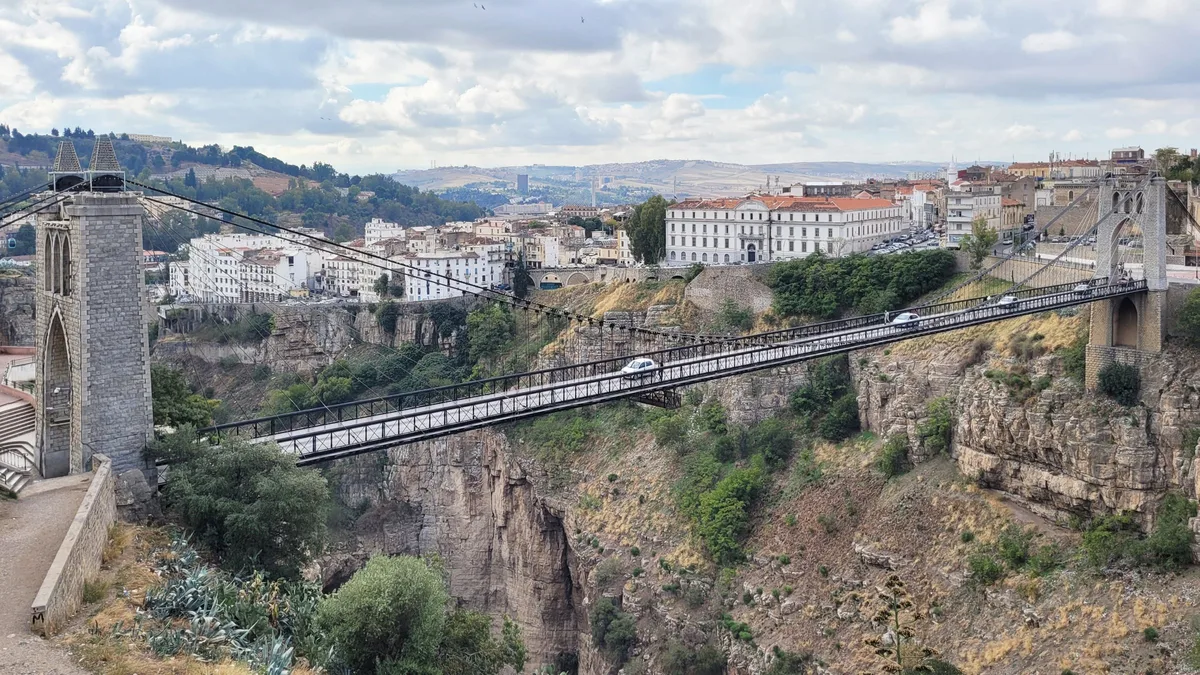
Begin with the rock, because Constantine does. The old city occupies a plateau of limestone almost entirely ringed by the gorge of the Oued Rhumel, which enters at one corner, wraps the rock in a near-circle of cliffs, natural arches and waterfalls, and leaves at the other. It is one of the great natural fortresses of the Mediterranean world — which is why the Numidian kings made it their capital, Cirta; why Rome rebuilt it; and why, after its destruction in civil wars, the emperor Constantine raised it again and gave it his name in the 4th century. The name stuck for seventeen centuries. The fortress logic is still legible from any bridge: one way in, water below, sky everywhere.
The crossings, in the order the city built them
El Kantara — the oldest argument. At the gorge's narrow waist, a bridge has stood since Roman times in one form or another; the present El Kantara bridge carries a Roman name in Arabic dress — qantara simply means "the bridge" — and its successive rebuildings (Ottoman-era masonry under the French, then the modern span) mark the city's original door, between the old rock and the station quarter.
Sidi Rached (1912) — the stone giant. When it opened, the Sidi Rached viaduct was among the largest stone-arch bridges in the world: a procession of arches striding across the gorge's southern mouth, carrying the road toward the new city. It is the bridge of Constantine's confident colonial morning — engineering as proclamation.
Sidi M'Cid (1912) — the icon. The suspension bridge everyone photographs: a deck hung from cables well over a hundred metres above the river's thread, opened the same year as Sidi Rached, linking the old town's hospital hill to the Sidi M'Cid quarter across the void. Walk it. The deck is generous, the parapet is honest, and halfway across, with the swifts screaming in the updraft and the old rock turning gold, you understand that Constantine does not have a postcard view — it has a postcard address, and this is it.
The modern spans. The 20th and 21st centuries added their own signatures: the great cable-stayed bridge of the new town (the Transrhumel viaduct, among Africa's largest of its kind when it opened in 2014), and the cable car — the télécabine — which since 2008 has floated residents over the gorge as public transport, not as a tourist ride. That is the detail to keep: in Constantine, even the spectacular crossings are commutes.
The two banks the bridges serve
A bridge is only an argument if both sides matter. On the old rock: the Casbah quarter's lanes; the palace of Ahmed Bey (built 1826–1835), the last bey's residence — a garden courtyard palace of marble, tile and painted ceilings that ranks among Algeria's finest Ottoman-era buildings; the mosques and the covered markets of the Souika, the old town's living commercial heart; and the museum of Cirta, holding the Numidian and Roman layers in cases. On the other bank: the colonial grid and its arcades, the theatre, the station quarter, and the modern city's sprawl of universities and hospitals — crowned by the Emir Abdelkader mosque, completed in 1994, one of the largest mosques in Africa, its twin minarets visible from every span. The bridges do not connect a monument to a suburb. They connect two complete cities that happen to share a name and a river's wound.
Walking the gorge city
Constantine is walked vertically and crossed constantly. A first day assembles itself: the old rock in the morning (palace, Souika, museum), down to El Kantara for the gorge's geology lesson — the natural bridge and the waterfalls beneath the spans — then across Sidi M'Cid at the golden hour, and the new bank for dinner. Add a second day for the cable car, the Abdelkader mosque, and the slow circumference walk along the gorge rim boulevards, where every railing is a belvedere. The city's practicalities follow our Algiers pattern: cash in dinars, taxis by agreement, Friday's altered rhythm — with one addition: Constantine's airport (Mohamed Boudiaf, CMF) lies roughly 10 kilometres south, with domestic flights and services toward the Mediterranean; verify current schedules before building on them.
Frequently asked questions
Why is Constantine called the city of bridges? Because its ancient rock is cut by the Rhumel gorge, and eight bridges — Roman-descended, Ottoman, colonial-engineered and contemporary — stitch the two halves of the city together. The crossings are its defining structures.
Which bridge should I walk first? Sidi M'Cid, the 1912 suspension bridge: the icon, the view, and the swifts. Then El Kantara for the history, and the cable car for the commute Constantine actually uses.
What is the Ahmed Bey palace? The residence built 1826–1835 by Constantine's last bey, in the old town: a courtyard palace of gardens, marble and painted decoration, among the finest Ottoman-era palaces in Algeria.
How do I reach Constantine? By domestic flight to Mohamed Boudiaf airport (roughly 10 km south), by train on the Algiers–east axis, or by road. Schedules change; verify before travel.
How long does Constantine need? Two days: one for the old rock and the great spans, one for the new bank, the mosque and the gorge rim. It pairs naturally with Djémila and the east — see Algeria Without the Crowds.
Algeria Splendors writes from Algeria. Companion reading: Algeria Without the Crowds: Seven World Heritage Sites, No Queues · Algiers, Practically · Algeria Visa Guide