ALGERIA SPLENDORS
A city dossier; facts follow the standard documented record, checked against our research notes in November 2026. For the mountain country behind the coast, this guide is the companion of our Kabylie reading across the journal; for the heritage frame, see Algeria Without the Crowds.
The mountain that guards the bay
Yemma Gouraya — "Mother Gouraya" — is the green cone, some 660 metres high, that closes Béjaïa's bay to the west, crowned by a colonial-era fort and wrapped in the Gouraya national park (a UNESCO biosphere reserve): Aleppo pines, Barbary macaques on the paths, and a summit view that takes in the whole grammar of the place — port below, cliffs east, the Soummam's green corridor running south into Kabylie. Algerians will tell you the mountain's silhouette is a sleeping woman watching over the city. Stand on the port at dusk, when the cone turns violet, and you will not argue.
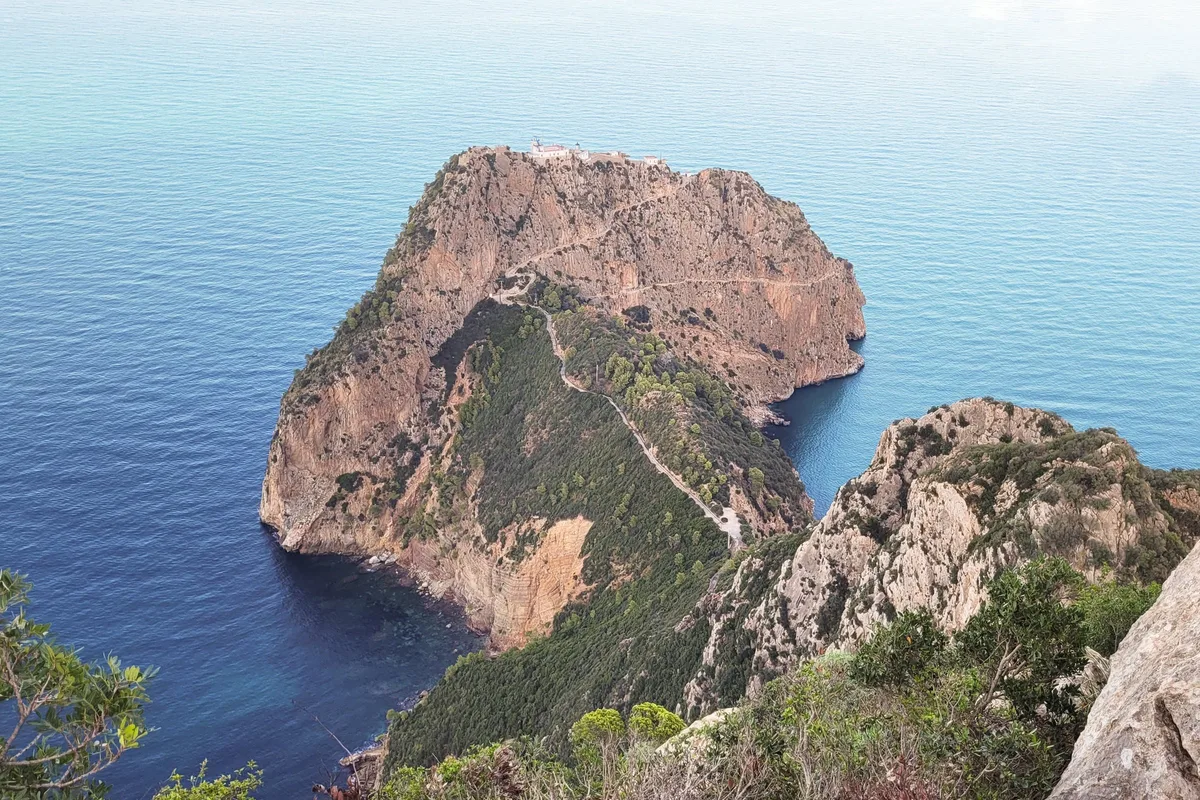
East of the city the coast sharpens into Cap Carbon: a narrow, wooded headland ending in cliffs that fall some 200 metres and more into very blue water, with a lighthouse at the point — reached by a walking path (the sentier des singes, the monkeys' path, named for the macaques) through the park. It is routinely described as one of the tallest sea-cliff lighthouses in the world; what matters on the ground is simpler — it is the wildest half-day in Béjaïa, an hour from a café terrace.
A port that taught mathematics
Béjaïa's depth is not only scenic. In the Middle Ages this was Bougie — a Hammadid capital, then Almohad, then a trading republic of the western Mediterranean, famous enough that its wax gave French the word for a candle: bougie. It was also a city of scholars; among those who studied and taught here was the young Leonardo Fibonacci, whose father ran the Pisan customs house — the future author of the Liber Abaci (1202), the book that carried Hindu-Arabic numerals into European commerce, learned his first mathematics in Béjaïa's counting houses. Few ports can claim to have changed how the world counts. The visible layers sit close together: the Casbah of Béjaïa above the port (Almohad in origin, rebuilt under the Spanish and the French), the Bab el Bahr — the Sea Gate — that once opened the medina to the harbour, the old port's arsenal quarter, and the Spanish fort of Bordj Moussa watching from its rise.
The Soummam: the door inland
A port is a promise; the Soummam valley is where Béjaïa keeps it. The river runs south-east from the city into the heart of Kabylie — gorges at Kherrata, olive country, and the road to Sétif — and the valley carries the region's modern memory as well as its trade: at Ifri, in this valley, the Soummam Congress of August 1956 gave the Algerian revolution its political charter. For the traveller, the valley is the hinge of the whole region: coast in the morning, mountain villages by afternoon — Tizi Ouzou and the Djurdjura beyond — with Béjaïa's cafés waiting at the sea end of the day. Our visa guide and money guide cover the framework; the mountain chapters of this journal cover the rest.
Béjaïa, practically
Béjaïa has its own airport (Soummam–Abane Ramdane, BJA) in the valley south of the city, with domestic services — verify schedules before building on them — and the rail and road axes tie it to Algiers (some 260 kilometres west) and to Sétif and Constantine inland. In town, the rhythm is Kabyle and maritime: the port terraces for grilled fish, the climb to the Casbah and Gouraya for the views, Cap Carbon for the wild half-day, and the beaches east and west (Tichy, Aokas, and the coves toward Jijel) for the summer self of the city. Come in late spring or early autumn and you will share it mostly with its own people — which, in Béjaïa, is the point.
Frequently asked questions
What is Béjaïa known for? The bay under Yemma Gouraya, the Cap Carbon lighthouse cliffs, its medieval past as Bougie — the trading port that gave French its word for candle and taught Fibonacci his numerals — and its role as Kabylie's door on the Mediterranean.
What is Yemma Gouraya? The wooded mountain (about 660 m) guarding Béjaïa's bay, a national park and biosphere reserve with a summit fort and the city's defining view. Its silhouette is locally read as a sleeping guardian.
How far is Cap Carbon, and how do I visit? Just east of the city, reached on foot through the Gouraya national park by the monkeys' path — a half-day's walk among pines and macaques to the lighthouse above cliffs of some 200 metres.
How do I reach Béjaïa? By domestic flight to Soummam–Abane Ramdane airport in the valley, by train or road from Algiers (about 260 km) or from Sétif and Constantine inland. Verify schedules before travel.
When is Béjaïa at its best? Late spring and early autumn: warm sea air, green mountains, and the city in its own hands. High summer belongs to Algeria's beach crowds.
Algeria Splendors writes from Algeria. Companion reading: Algeria Without the Crowds · Algiers, Practically · Constantine: The City That Bridges Built Twice