ALGERIA SPLENDORS
: How Algeria’s Oasis Water Knowledge Still Lives
In the Algerian Sahara, water does not arrive as a neutral utility. It arrives through terrain, labour, measurement, custom and agreement. A foggara is often introduced as an ancestral underground irrigation channel that brings groundwater to an oasis. This is true, but it is not yet the whole truth.
The fuller story begins with people. UNESCO’s safeguarding notice concerns not only the channels, but the knowledge and skills of the water measurers of the foggaras in the ksour communities of Touat and Tidikelt. Those measurers calculate water shares, help repair distribution combs and guide water through the channel. UNESCO also names owners, manual workers and accountants among the social agents connected by a foggara. [1]
To call the system “ancient irrigation” is therefore accurate in the narrowest technical sense and incomplete in the human one. It can make water sound like a museum object rather than a social practice. The question worth asking is not only how does a foggara work? It is also: who knows how to keep it meaningful, and under what conditions can that knowledge continue?
A small glossary for looking more carefully
| Term | What it means | |---|---|---| | Foggara | A gravity-fed irrigation system that captures groundwater through an underground gallery and distributes it to oasis users. | | Kasria | A surface distribution structure that divides a running flow into shares linked to water rights. | | Seguia | An open channel carrying a water share from the distribution point. | | Water measurer / water bailiff | A bearer of knowledge involved in measuring shares, repairing distribution devices and directing water. | | Living water heritage | A framing used in this article for a system whose physical infrastructure and social rules are maintained, contested and adapted over time. |
The architecture is underground; the institution is in public
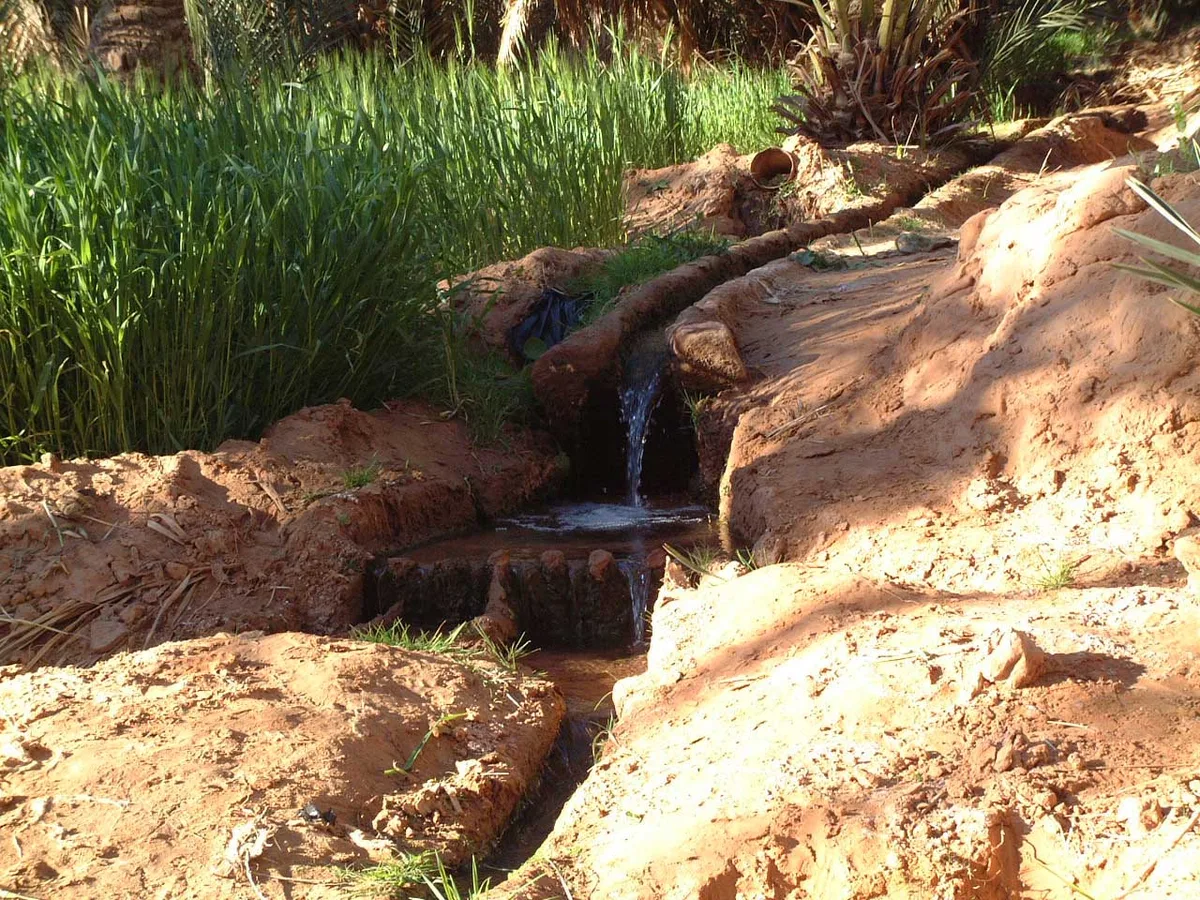
A foggara can be described as an inclined underground gallery with regularly spaced shafts. Water is brought to the surface by gravity, then divided through a kasria and carried through open channels, or seguia, to holders of water rights. [2] That physical sequence is useful, but it should not conceal the social sequence beside it.
Fact. The study by Salem Idda, Bruno Bonté, Marcel Kuper and Hamidi Mansour explains that the foggara’s operation is tied to maintenance, collectively recognised water rights and local arrangements for conflict resolution. It also describes the roles of the djemâa and zawiya in the wider oasis context examined by the authors. [2]
Interpretation. The gallery may be underground, but the water order is not. A foggara makes visible a difficult principle for contemporary readers: infrastructure is never only infrastructure. A channel moves water; a community decides how that movement becomes a share, a responsibility or a dispute.
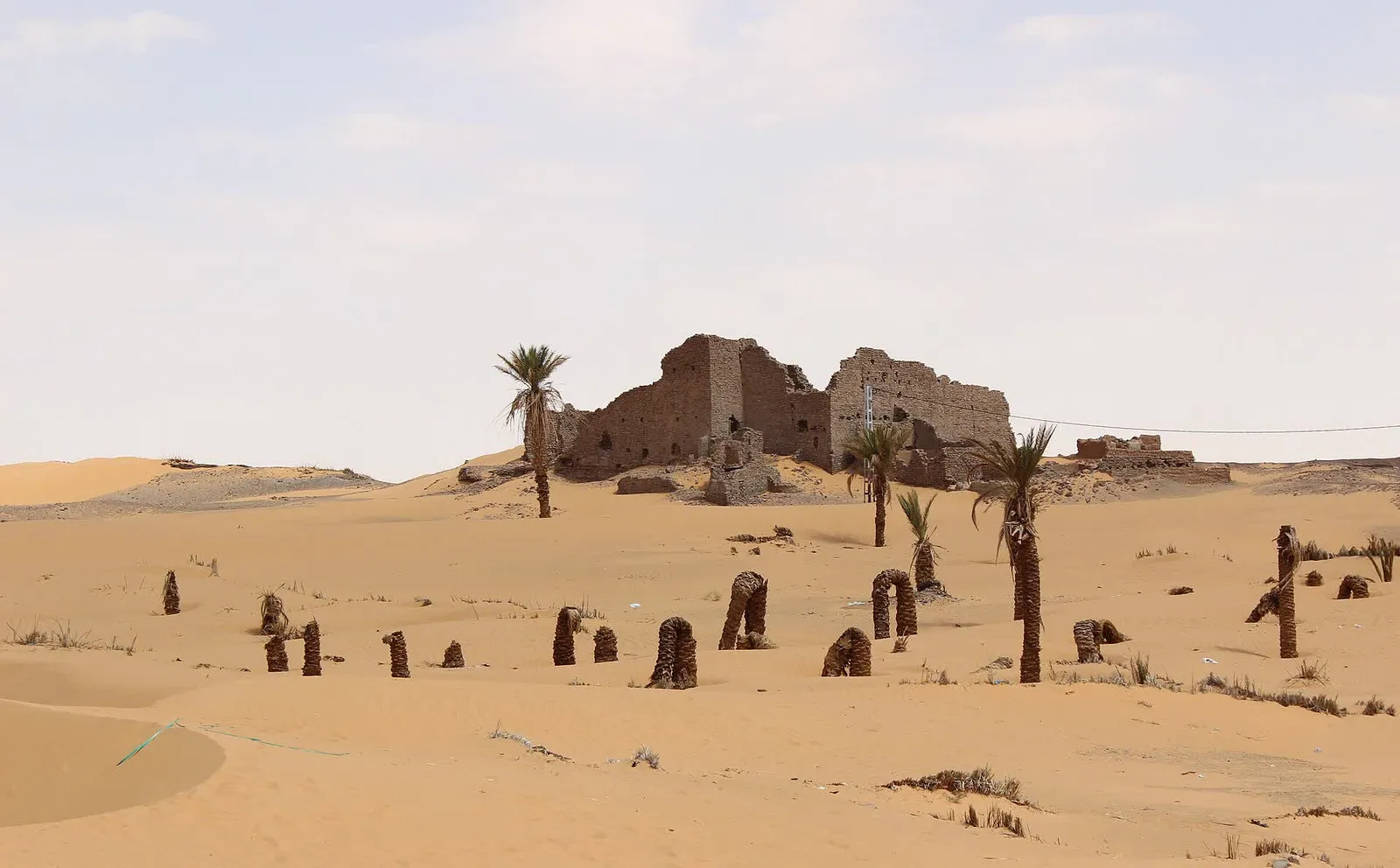
This is why a close visual of a shaft, a channel or a palm grove—however beautiful—cannot tell the whole story. Without the people who measure, repair, remember and negotiate, the image can turn a working system into an empty sign of “the desert.”
Misconception correction: neither frozen relic nor simple story of disappearance
There is a powerful temptation to narrate the foggara as a flawless relic from the past, now inevitably vanishing. That story has emotional force, but it flattens the evidence.
UNESCO explicitly identifies pressures on the knowledge of water measurers: aging practitioners, interrupted transmission, urbanisation, modernisation, changes in ownership relations and insufficient attention to how knowledge passes to younger people. [1] These are serious safeguarding concerns, not decorative footnotes.
At the same time, Idda and co-authors challenge the assumption that foggaras should be understood as immutable systems whose only possible future is decline. Their 2021 research, based on fieldwork in Touat, Gourara and Tidikelt, documents continued use and examines adaptations in infrastructure, institutions and collective action. The authors argue that preservation understood only as keeping an unchanged physical form can obscure how a living system responds to social and environmental transformation. [2]
Editorial conclusion, not a factual claim: A responsible article should hold both truths together. Transmission can be under threat, and communities can still adapt. The right response is neither romantic rescue narrative nor technological triumphalism; it is patient attention to the people who define continuity on their own terms.
Three lenses for reading a foggara
| Lens | What it reveals | What it prevents us from saying too quickly |
|---|---|---|
| Water | The material movement of groundwater, gravity and distribution. | “It is just an old tunnel.” |
| Rights and maintenance | Shares, repairs, collective labour and the practical work of keeping water moving. | “Technology alone explains the oasis.” |
| Transmission | The knowledge of measuring, negotiating and learning across generations. | “Heritage survives because it is photographed or listed.” |
The three lenses create a more useful cultural framework. They also make space for uncertainty. The available sources do not authorise a blanket statement about every foggara, every oasis or every community today. Conditions differ by place, aquifer, governance, livelihood and generation. This article deliberately avoids presenting one oasis as the Sahara or one historical account as a timeless rule.
From a channel to a cultural question
The water measurer is a particularly revealing figure because the role is both intellectual and manual. UNESCO says that measurers can be called upon continuously by the community and that their knowledge appears to be under threat. [1] A photograph of a measuring tool, then, should not be treated as a piece of decorative nostalgia. It should lead to questions: Who identifies the share? Who maintains the device? Who is learning the work? Who has the authority to describe it for a public audience?
The academic research adds another necessary complication. It records that changes such as pumped groundwater, urbanisation and altered labour relations can disrupt foggara systems; it also observes cases in which communities adjusted practices and institutions. [2] This does not supply a single prescription. It does, however, make a richer editorial invitation: listen for the difference between a system being preserved as an object and a system being kept alive as a practice.
What a visitor—or a reader far away—can do with this knowledge
First, resist the instant symbolism. A foggara is not proof that an oasis is frozen in time, and it is not an image bank for generic “Sahara” content.
Second, follow provenance. If an article uses a portrait of a water measurer, an image of a ksar or a recording of local speech, the caption should name the person, place, creator, date, consent condition and licence. When these details are unknown, publication should pause.
Third, accept that some knowledge is not ours to extract. A cultural reader can learn from a public explanation of water systems without demanding access to every local practice, route or personal history. This is especially important where visibility can create pressure on places, people and cultural work.
A return, not a shortcut
For members of a diaspora, a foggara can prompt a return to family vocabulary: the name of a place, a remembered garden, the sound of water arriving at a different hour, a story whose details have been lost in migration. For readers without that inheritance, it can be an invitation to slow down before calling a landscape empty.
Interpretation. Algeria Splendors uses “return” here not as a claim that everyone must travel back, nor as an instruction to recover a pure past. It means returning to the relationships that make a place legible: the people who maintain it, the words that describe it, the archives that complicate it and the limits that protect it.
A foggara does not ask to be admired only for surviving. It asks a harder question: when water, work and memory belong to a community, what does it mean for an outsider to tell the story well?
Culturally appropriate CTA
If this story recalls a word, a water practice, a family archive or a local source from Touat, Gourara or Tidikelt, share it with Algeria Splendors only if you are comfortable being contacted—and tell us whether it may be quoted, credited, anonymised or kept off the record.
FAQ
What is a foggara? A gently sloping underground gallery that captures groundwater at the foot of a plateau and carries it, by gravity alone, to an oasis — where a comb-like stone distributor (the kasria) divides the flow into measured shares for each garden.
Where are Algeria's foggaras? In the south-western oases of the Touat, Gourara and Tidikelt regions, around Timimoun and Adrar, where chains of vertical shafts still mark the gallery lines across the hamada.
Why is the foggara on a UNESCO list? UNESCO inscribed the knowledge and skills of the foggara water measurers of the Touat and Tidikelt on its List of Intangible Cultural Heritage in Need of Urgent Safeguarding — the measurers who calculate and guard each family's share are the living core of the system.
Can a visitor see a foggara? Yes — in the oases of the Gourara and Touat, local guides can show the shaft lines, the open channels (seguias) and a kasria at work. Visits are arranged on the ground, and the water system itself remains community property, not a monument.
Sources
- UNESCO Intangible Cultural Heritage — Knowledge and skills of the water measurers of the foggaras of Touat and Tidikelt: https://ich.unesco.org/en/USL/knowledge-and-skills-of-the-water-measurers-of-the-foggaras-or-water-bailiffs-of-touat-and-tidikelt-01274
- Idda, Bonté, Kuper & Mansour (2021), "Revealing the Foggara as a Living Irrigation System through an Institutional Analysis", International Journal of the Commons: https://doi.org/10.5334/ijc.1128
Fact-checked 27 August 2026. Algeria Splendors is an independent cultural publication from Algeria.